

Hey there, fellow brewing enthusiasts! I'm a supplier of 30BBL brewing systems, and today I'm stoked to dive deep into the capacity of a 30BBL brewing system.
First off, let's break down what "30BBL" actually means. BBL stands for "barrel," and in the brewing world, a barrel is a unit of volume. One barrel is equivalent to 31 gallons in the United States. So, when we're talking about a 30BBL brewing system, we're looking at a system that can produce 30 barrels of beer per batch. That translates to 30 x 31 = 930 gallons of beer in one go.

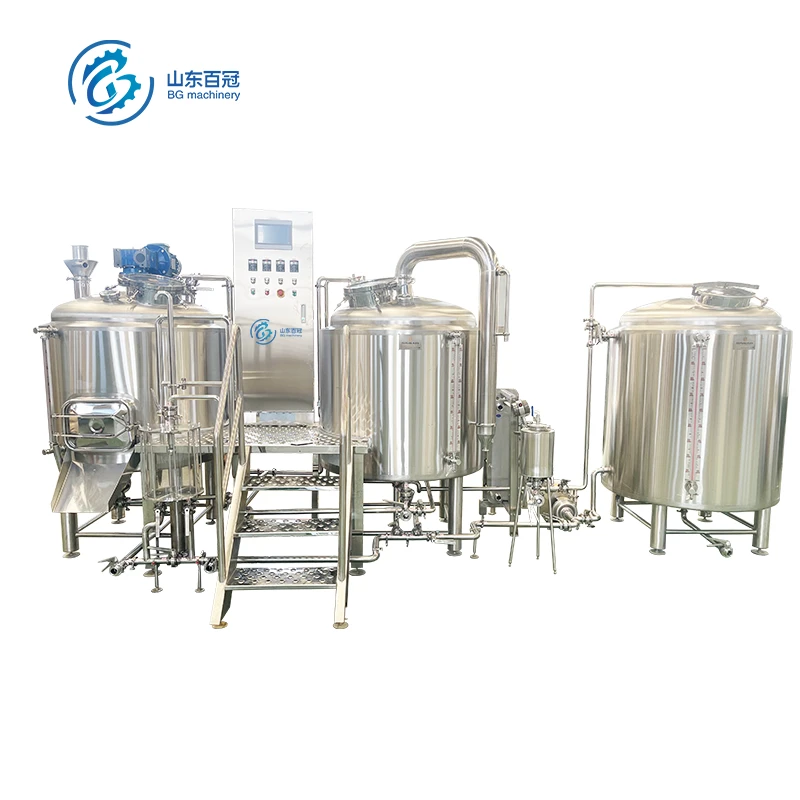
Now, why is this capacity so important? Well, for commercial breweries, it's all about meeting the demand. If you're running a medium - sized brewery, a 30BBL system gives you a good balance between production volume and manageability. You can produce a decent amount of beer to supply local bars, restaurants, and even some regional distribution channels without going overboard.
Let's talk about the different stages of the brewing process and how the 30BBL capacity plays out.
Mash Tun
The mash tun is where the magic starts. It's the vessel where the grains are mixed with hot water to convert starches into fermentable sugars. In a 30BBL brewing system, the mash tun needs to be large enough to hold the right amount of grains and water for a 30BBL batch. Typically, it has to handle around 2,500 - 3,000 pounds of grains, depending on the recipe. This is a significant amount, but it's manageable with the right equipment and processes.
Lauter Tun
After mashing, the liquid (wort) needs to be separated from the spent grains in the lauter tun. The 30BBL capacity means that the lauter tun has to be designed to efficiently separate the wort from a large volume of grains. It has to have a proper false bottom and a well - thought - out sparging system to ensure that we get as much of the fermentable sugars out of the grains as possible.
Boiling Kettle
Once the wort is in the boiling kettle, we add hops and other flavorings. A 30BBL boiling kettle needs to be able to heat up a large volume of liquid quickly and maintain a rolling boil for the required time. This usually involves a powerful heating system, whether it's steam - heated or direct - fired. The boiling process also helps to sterilize the wort and is crucial for developing the flavor and aroma of the beer.
Fermentation Tanks
After boiling, the wort is cooled and transferred to the fermentation tanks. A 30BBL system will typically need one or more fermentation tanks to hold the entire batch. These tanks need to be able to control the temperature precisely during fermentation, as different beer styles require different fermentation temperatures. They also need to be airtight to prevent contamination and allow for the production of carbon dioxide, which is a by - product of fermentation.
Conditioning Tanks
Once fermentation is complete, the beer is transferred to conditioning tanks. Here, it matures and clarifies. The 30BBL capacity means that the conditioning tanks have to be large enough to hold the beer for the required time, which can range from a few days to several weeks depending on the style of beer.
Now, let's compare the 30BBL brewing system with some other options. If you're just starting out or have a very small operation, a 500L 5HL Beer Brewhouse might be a better choice. It has a much smaller capacity, which is great for testing recipes and serving a very local market. On the other hand, if you're looking for a more high - end, visually appealing option, a Copper Brewhouse could be the way to go. Copper has some unique properties that can enhance the brewing process, and it looks really cool in a brewery setting.
But for many medium - sized commercial breweries, the 30BBL Brewing Equipment is the sweet spot. It allows you to scale up your production without having to invest in a massive, overly complex system.
One of the things I love about the 30BBL brewing system is its flexibility. You can brew a wide variety of beer styles, from light lagers to heavy stouts. The capacity gives you enough room to experiment with different recipes and ingredients while still being able to produce a consistent product.
Another advantage is the cost - effectiveness. Compared to larger systems, a 30BBL system is more affordable in terms of initial investment and operating costs. You don't need as much floor space, and the energy consumption is relatively lower. At the same time, it still allows you to generate a good revenue stream by producing a significant amount of beer.
When it comes to maintenance, a 30BBL brewing system is also relatively easy to manage. The components are of a size that can be serviced and repaired without too much hassle. Of course, regular maintenance is crucial to keep the system running smoothly and to ensure the quality of the beer.
So, if you're thinking about starting a brewery or expanding an existing one, a 30BBL brewing system could be the perfect fit. It offers a great balance of capacity, flexibility, and cost - effectiveness.
If you're interested in learning more about our 30BBL brewing systems or have any questions about the brewing process in general, don't hesitate to reach out. We're here to help you make the best decision for your brewery. Whether you're a seasoned pro or just starting out, we can provide you with the information and support you need to get your brewing operation up and running.
Contact us today to start the conversation about how a 30BBL brewing system can take your brewery to the next level.
References
- American Society of Brewing Chemists (ASBC) Handbook
- Brewing Techniques Magazine, various issues
- "The Complete Joy of Homebrewing" by Charlie Papazian