

Carbon dioxide (CO₂) plays a multifaceted and crucial role in the fermentation process within a conical beer fermenter. As a leading supplier of Conical Beer Fermenters, I have witnessed firsthand the diverse impacts of CO₂ on fermentation, from influencing the flavor and texture of the final product to affecting the efficiency of the brewing process. In this blog post, I will delve into the scientific aspects of CO₂'s effects on fermentation in a conical beer fermenter and explore how these effects can be harnessed to produce high - quality beer.
CO₂ Production during Fermentation
During the fermentation of beer, yeast consumes sugars and converts them into ethanol and carbon dioxide through the process of anaerobic respiration. In a conical beer fermenter, this CO₂ is produced continuously as the yeast is actively metabolizing. The rate of CO₂ production depends on several factors, such as the yeast strain, the initial sugar concentration in the wort, and the fermentation temperature.
Most yeast strains have an optimal temperature range for fermentation. For example, ale yeasts typically ferment best between 15 - 24°C (59 - 75°F), while lager yeasts prefer lower temperatures, around 7 - 13°C (45 - 55°F). At higher temperatures, yeast metabolism is generally more active, leading to a faster rate of CO₂ production. The initial sugar concentration in the wort also has a significant impact. A higher sugar content provides more substrate for the yeast, resulting in greater CO₂ generation. For instance, a strong beer with a higher original gravity will produce more CO₂ compared to a light - bodied beer.
Physical Effects of CO₂ in the Fermenter
One of the most noticeable physical effects of CO₂ in a conical beer fermenter is its role in creating a natural agitation. As CO₂ is produced, it rises through the liquid in the form of bubbles. This upward movement of bubbles causes a gentle stirring effect within the fermenter. The agitation helps to keep the yeast in suspension, ensuring that all parts of the wort are exposed to the yeast for efficient fermentation. It also helps to distribute heat evenly throughout the fermenter, preventing hot or cold spots that could negatively impact the fermentation process.
Moreover, the CO₂ produced during fermentation forms a layer on top of the liquid in the conical beer fermenter. This layer acts as a protective blanket, preventing oxygen from entering the fermenter. Oxygen is detrimental to the fermentation process as it can cause oxidation of the beer, leading to off - flavors and a shorter shelf - life. By creating a CO₂ barrier, the fermenter helps to maintain the quality of the beer during fermentation.
Impact on Yeast Activity
Carbon dioxide can also have a direct impact on yeast activity. At low to moderate levels, CO₂ can enhance yeast growth and fermentation efficiency. It can stimulate the yeast's metabolism by increasing its membrane permeability, allowing for better uptake of nutrients from the wort. However, at high levels, CO₂ can become inhibitory to yeast.

Excess CO₂ can cause a decrease in the pH of the wort. As CO₂ dissolves in the liquid, it forms carbonic acid (H₂CO₃), which dissociates into hydrogen ions (H⁺) and bicarbonate ions (HCO₃⁻). The increase in hydrogen ions leads to a lower pH, which can stress the yeast cells. High levels of CO₂ can also inhibit the ability of yeast to take up essential nutrients, such as amino acids and sugars. This can slow down the fermentation process and lead to incomplete fermentation, resulting in a beer with residual sugars and a lower alcohol content.
Flavor and Aroma Development
The presence of CO₂ in the conical beer fermenter has a profound impact on the flavor and aroma of the final beer. CO₂ is involved in the extraction and retention of volatile flavor compounds. Some of the volatile compounds responsible for the characteristic aroma and flavor of beer, such as esters and higher alcohols, are produced by the yeast during fermentation. CO₂ helps to carry these compounds to the surface of the liquid, where they can be detected by the senses.
In addition, CO₂ itself contributes to the mouthfeel of the beer. The carbonation level, which is determined by the amount of dissolved CO₂, gives the beer its characteristic fizz. A well - carbonated beer has a refreshing and lively mouthfeel, while a beer with insufficient carbonation can seem flat and unappealing. Different styles of beer require different levels of carbonation. For example, a Belgian witbier typically has a high level of carbonation, giving it a light and effervescent quality, while a traditional English ale may have a lower level of carbonation, resulting in a smoother and more mellow mouthfeel.
Managing CO₂ in the Fermentation Process
As a Conical Beer Fermenter supplier, we understand the importance of managing CO₂ levels during fermentation. Our Commercial Beer Fermentation Tank is designed with features that allow brewers to control the production and release of CO₂. For instance, the fermenters are equipped with pressure - relief valves that can be adjusted to maintain a specific pressure inside the tank. By controlling the pressure, brewers can regulate the amount of CO₂ that remains dissolved in the beer.
Our Pressurized Conical Fermenter takes this control to the next level. It allows brewers to ferment the beer under pressure, which can have several advantages. Fermenting under pressure can suppress the production of certain off - flavors, such as diacetyl, and can also increase the solubility of CO₂ in the beer. This results in a more consistent carbonation level and a better - tasting beer.
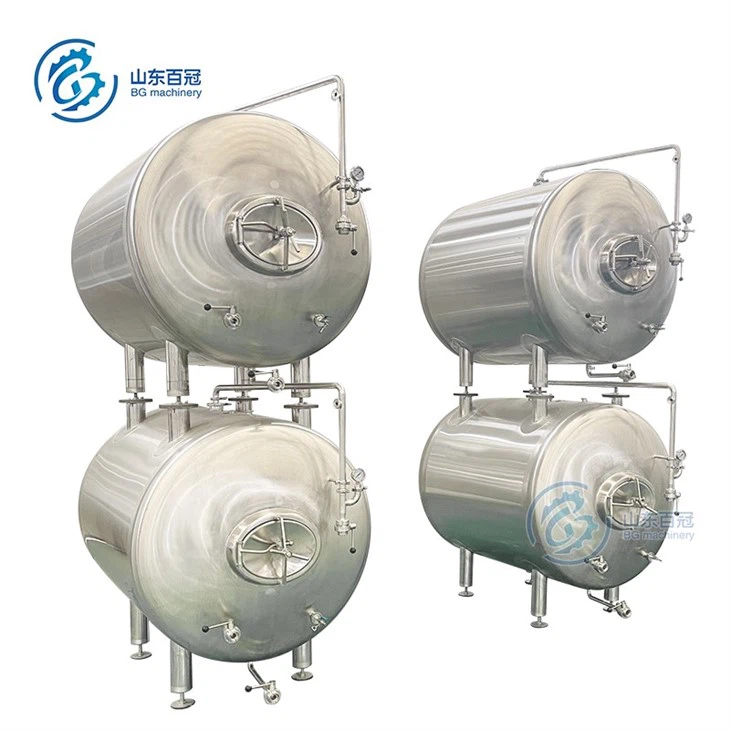
The Horizontal Stacked Brite Tanks we offer are also important in the management of CO₂. After fermentation, the beer is transferred to these brite tanks for conditioning. During conditioning, the CO₂ levels can be further adjusted to achieve the desired carbonation level for the final product.
Impact on the Overall Brewing Process Efficiency
Efficient management of CO₂ can also improve the overall brewing process efficiency. By controlling the CO₂ production and release, brewers can reduce the time required for fermentation and conditioning. For example, by fermenting under pressure in a conical fermenter, the yeast can work more efficiently, leading to a faster fermentation time.
In addition, the ability to capture and reuse CO₂ can also contribute to cost savings. Some modern conical beer fermenters are equipped with CO₂ recovery systems. These systems can capture the CO₂ produced during fermentation and reuse it for carbonation or other processes in the brewery. This not only reduces the need to purchase additional CO₂ but also has environmental benefits by reducing greenhouse gas emissions.
Conclusion
In conclusion, carbon dioxide has a far - reaching impact on fermentation in a conical beer fermenter. From influencing yeast activity and flavor development to affecting the physical properties of the beer and the efficiency of the brewing process, CO₂ is a key factor in producing high - quality beer. As a Conical Beer Fermenter supplier, we are committed to providing brewers with the tools and technology needed to manage CO₂ effectively in their fermentation processes.
If you are a brewer looking to optimize your fermentation process and produce better - tasting beer, we invite you to contact us for further discussion on our Commercial Beer Fermentation Tank, Pressurized Conical Fermenter, and Horizontal Stacked Brite Tanks. Our team of experts is ready to assist you in finding the best solutions for your brewing needs.
References
- American Society of Brewing Chemists. (2023). Technical Quarterly.
- Bamforth, C. W. (2009). Beer: Quality, Safety and Nutritional Aspects. Woodhead Publishing.
- Kunze, W. (2019). Technology Brewing and Malting. VLB Berlin.