

Adjusting the alcohol strength of beer brewed by a 7BBL Brewing System is a crucial skill for ensuring the quality and consistency of your brews. As a supplier of 7BBL Brewing Systems, I understand the importance of this process and am here to share some valuable insights.
Understanding the Basics of Alcohol in Beer
Before delving into the adjustment methods, it's essential to understand how alcohol is produced during the brewing process. Alcohol is a by - product of fermentation, where yeast consumes sugars in the wort and converts them into alcohol and carbon dioxide. The amount of sugar available in the wort directly influences the final alcohol content of the beer. In a 7BBL Brewing System, the initial sugar concentration, also known as the original gravity (OG), is a key factor in determining the potential alcohol strength.
Measuring Original Gravity and Final Gravity
To accurately adjust the alcohol strength, you need to measure the original gravity (OG) of the wort before fermentation and the final gravity (FG) after fermentation. The difference between these two values can be used to calculate the alcohol by volume (ABV) of the beer. You can use a hydrometer or a refractometer for these measurements. A hydrometer is a traditional tool that measures the density of the liquid, while a refractometer measures the refractive index, which is related to the sugar content.
The formula to calculate ABV is:
[ABV=\frac{(OG - FG)\times131.25}{1}]
For example, if your OG is 1.050 and your FG is 1.010, the ABV would be (\frac{(1.050 - 1.010)\times131.25}{1}= 5.25%)
Increasing the Alcohol Strength
Adjusting the Wort Composition
One of the most straightforward ways to increase the alcohol strength is to increase the amount of fermentable sugars in the wort. You can do this by adding more malt or other fermentable adjuncts such as corn, rice, or sugar. When using a 7BBL Brewing System, you need to ensure that the additional ingredients are properly mixed into the wort during the mashing or boiling process.
- Malt: Different types of malt have different sugar - producing capabilities. For example, pale malt is a good source of fermentable sugars. You can increase the proportion of pale malt in your grain bill to boost the sugar content of the wort.
- Adjuncts: Corn and rice are common adjuncts that can be added to the mash. They are relatively inexpensive and can increase the fermentable sugar content without significantly altering the flavor of the beer. Sugar, such as table sugar or honey, can also be added during the boiling process. However, be careful not to overdo it, as too much sugar can lead to a harsh or unbalanced flavor.
Yeast Selection
The type of yeast you use can also have a significant impact on the alcohol strength. Some yeast strains are more alcohol - tolerant than others and can ferment to a higher alcohol level. For example, champagne yeast can tolerate higher alcohol concentrations and can be used to increase the ABV of your beer. When using a 7BBL Brewing System, make sure to pitch the appropriate amount of yeast according to the manufacturer's recommendations.
Fermentation Conditions
Maintaining the right fermentation conditions is crucial for achieving a high alcohol content. Yeast activity is affected by temperature, so it's important to keep the fermentation temperature within the optimal range for the yeast strain you are using. In general, higher temperatures can speed up the fermentation process, but they can also lead to off - flavors. For a 7BBL Brewing System, you may need to invest in a temperature - control system to ensure consistent fermentation conditions.
Decreasing the Alcohol Strength
Dilution
If you find that your beer has too high an alcohol content, one simple solution is to dilute it with water. However, this method should be used with caution, as it can also dilute the flavor of the beer. Before diluting, you need to calculate the amount of water needed to reach the desired alcohol strength.
Let's say you have a 7BBL batch of beer with an ABV of 8% and you want to reduce it to 6%. You can use the following formula:
[V_1\times ABV_1=V_2\times ABV_2]
where (V_1) is the initial volume of the beer, (ABV_1) is the initial alcohol by volume, (V_2) is the final volume of the beer, and (ABV_2) is the final alcohol by volume.
In this case, if (V_1 = 7BBL) and (ABV_1 = 8%) and (ABV_2=6%), then (V_2=\frac{V_1\times ABV_1}{ABV_2}=\frac{7\times8}{6}\approx9.33BBL). So you would need to add approximately (9.33 - 7 = 2.33BBL) of water.
Using Less Fermentable Sugars
Another way to decrease the alcohol strength is to use less fermentable sugars in the wort. You can reduce the amount of malt or adjuncts in your grain bill. You can also use non - fermentable sugars or dextrins, which will add body to the beer without increasing the alcohol content.
Quality Control and Consistency
When adjusting the alcohol strength of beer brewed by a 7BBL Brewing System, it's important to maintain quality control and consistency. Keep detailed records of your brewing process, including the ingredients used, the OG and FG measurements, and the fermentation conditions. This will help you reproduce successful batches and make adjustments as needed.
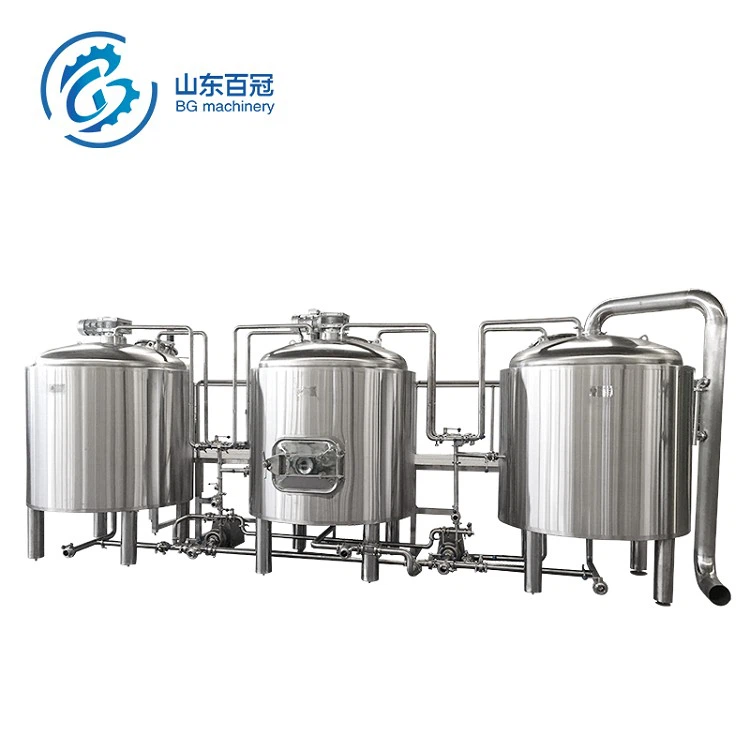

Related Brewing Systems
If you are interested in other brewing systems, we also offer a range of options, including the Nano Brewery System, which is suitable for small - scale brewing operations. Our 3 Vessels Brewhouse provides a more comprehensive brewing solution, and the 1500L Turnkey Beer Brewing System is ideal for medium - sized breweries.
Conclusion
Adjusting the alcohol strength of beer brewed by a 7BBL Brewing System requires a combination of knowledge, skill, and experience. By understanding the principles of fermentation, measuring the gravity accurately, and making appropriate adjustments to the wort composition, yeast selection, and fermentation conditions, you can produce beer with the desired alcohol content. If you have any questions or are interested in purchasing a 7BBL Brewing System or other related equipment, please feel free to contact us for more information and to start a procurement discussion.
References
- Daniels, R. (1996). Designing Great Beers: The Ultimate Guide to Brewing Classic Beer Styles. Brewers Publications.
- Fix, G., & Fix, B. (1999). An Analysis of Brewing Techniques. Brewers Publications.
- Kunze, W. (2019). Technology Brewing and Malting. VLB Berlin.